You pour milk into a measuring cup and the recipe calls for 400 ml. The problem: your container displays centiliters on one side, liters on the other, but no markings in milliliters. This situation, common in French kitchens, can be resolved in seconds with a simple conversion rule. 400 ml is exactly 0.4 liters, or four-tenths of a liter. Understanding this equivalence avoids approximations that can throw off a pancake batter or a broth.
Graduated measuring cup in centiliters: measure 400 ml without error
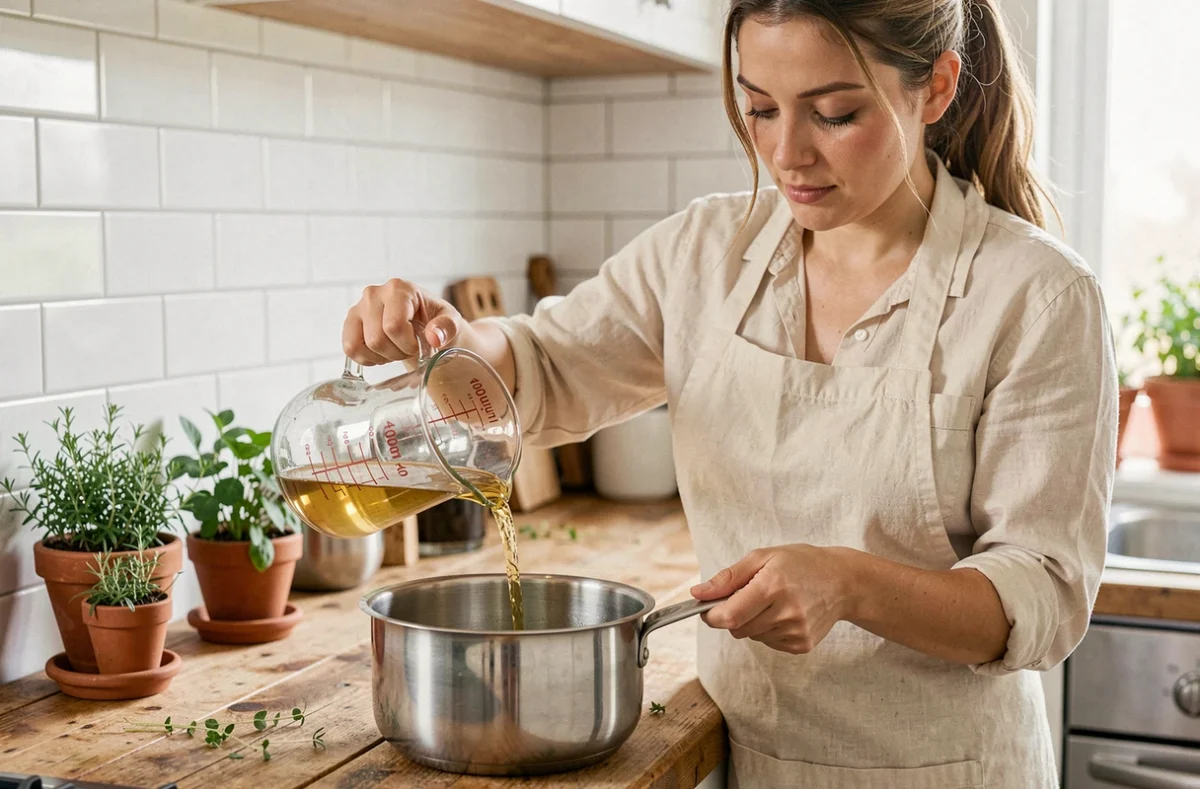
Most measuring cups sold in France show graduations in centiliters (cl) rather than milliliters. When your recipe calls for 400 ml, you just need to know that one centiliter contains ten milliliters.
400 ml therefore equals 40 cl. Fill your measuring cup to the 40 cl mark and you will have the exact volume required.
To read the level correctly, place the measuring cup on a perfectly horizontal surface. Position your eyes at the level of the liquid and locate the bottom of the meniscus, this slight curve formed by the surface of the water or milk in contact with the glass. Reading from above or below distorts the estimate by several milliliters, which can be enough to ruin a caramel or a custard.
If you want to delve deeper into the logic behind this operation, you can convert 400 ml to liters on Emploi Biz where the process is detailed step by step.
Milliliters to liters conversion: the method to remember
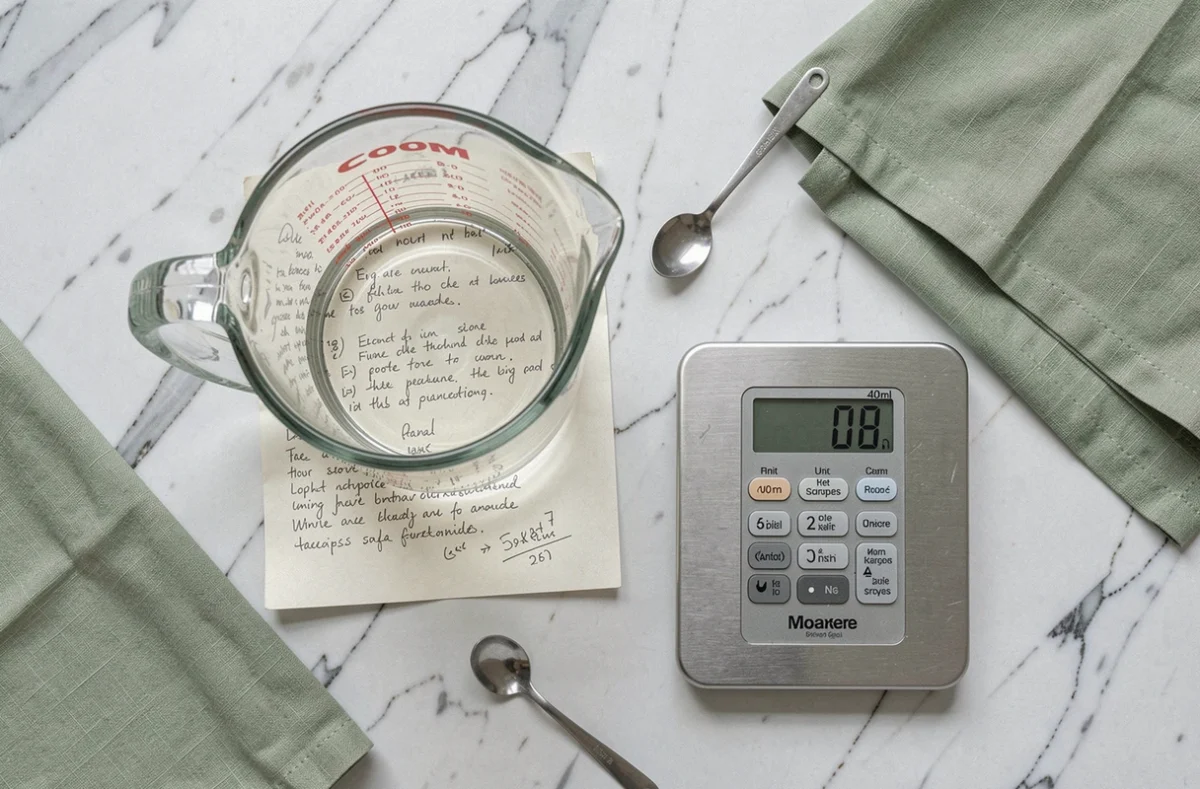
The principle can be summed up in one sentence. One liter contains one thousand milliliters. To convert from milliliters to liters, you divide by one thousand.
400 divided by 1,000 gives 0.4 L. You can apply this division to any quantity: 250 ml becomes 0.25 L, 750 ml becomes 0.75 L.
In cooking, three volume units are constantly referenced. Here’s their relationship:
- 1 liter (L) = 100 centiliters (cl) = 1,000 milliliters (ml)
- 1 centiliter (cl) = 10 milliliters (ml) = 0.01 liter (L)
- 1 milliliter (ml) = 0.1 centiliter (cl) = 0.001 liter (L)
With these three lines in mind, you can switch from one unit to another without a calculator. When an English recipe indicates 0.4 L of broth and your cup shows centiliters, you immediately know to aim for the 40 cl mark.
Why 400 ml of oil does not weigh 400 grams
You may have noticed that some measuring cups also display graduations in grams for flour, sugar, or rice. These scales are not interchangeable with milliliters. The reason: milliliters measure volume, grams measure mass.
For pure water, the correspondence is nearly perfect. 400 ml of water weighs about 400 g. The ratio changes as soon as you switch to another ingredient, because each substance has its own density.
Oil, for example, is lighter than water at equal volume. 400 ml of oil weighs significantly less than 400 g. Conversely, 400 ml of honey clearly exceeds 400 g on a scale.
When to weigh rather than measure a volume
Are you following a cake recipe that calls for 400 ml of flour? Caution. Packed flour in a measuring cup does not occupy the same volume as aerated flour. For dry ingredients, a scale is more reliable than a measuring cup.
Reserve the measuring cup for liquids: water, milk, cream, juice, oil, broth. For anything poured in powder or grain form, weigh it. Your recipe will gain consistency from one time to the next.

Quick conversion table for common volumes in cooking
Instead of pulling out the calculator for every recipe, this table groups the most requested equivalences.
| Milliliters (ml) | Centiliters (cl) | Liters (L) |
|---|---|---|
| 50 ml | 5 cl | 0.05 L |
| 100 ml | 10 cl | 0.1 L |
| 250 ml | 25 cl | 0.25 L |
| 400 ml | 40 cl | 0.4 L |
| 500 ml | 50 cl | 0.5 L |
| 750 ml | 75 cl | 0.75 L |
| 1,000 ml | 100 cl | 1 L |
Print this table and stick it inside a kitchen cupboard. At a glance, you can find the equivalence without interrupting your preparation.
Practical references with everyday containers
A standard mustard jar holds about 20 cl, or 200 ml. To get 400 ml, fill two of them. A typical 50 cl water bottle slightly exceeds 400 ml: pour it while stopping just before the bottom.
These references do not replace a measuring cup for baking, where precision matters. But for a risotto or a soup, they are very helpful.
Adapting a recipe when quantities change
You are doubling a recipe meant for four people. It calls for 200 ml of liquid cream, so you move to 400 ml, or 0.4 L. Converting first to liters simplifies multiplications when the volumes become significant.
To halve a recipe, the reasoning works in reverse. 400 ml becomes 200 ml, or 20 cl or 0.2 L. Keeping a single reference unit throughout the recipe avoids calculation errors between centiliters and milliliters.
One last often-overlooked point: 400 ml also corresponds to 400 cm³. If you encounter this unit in a culinary chemistry manual or on a foreign package, it is exactly the same volume. One milliliter equals one cubic centimeter, without exception.
The conversion of 400 ml to liters requires only a division by one thousand. This reflex, once acquired, works for all quantities and all recipes. Keep a reliable measuring cup, read the graduations at eye level, and reserve the scale for dry ingredients. The rest is just basic arithmetic.