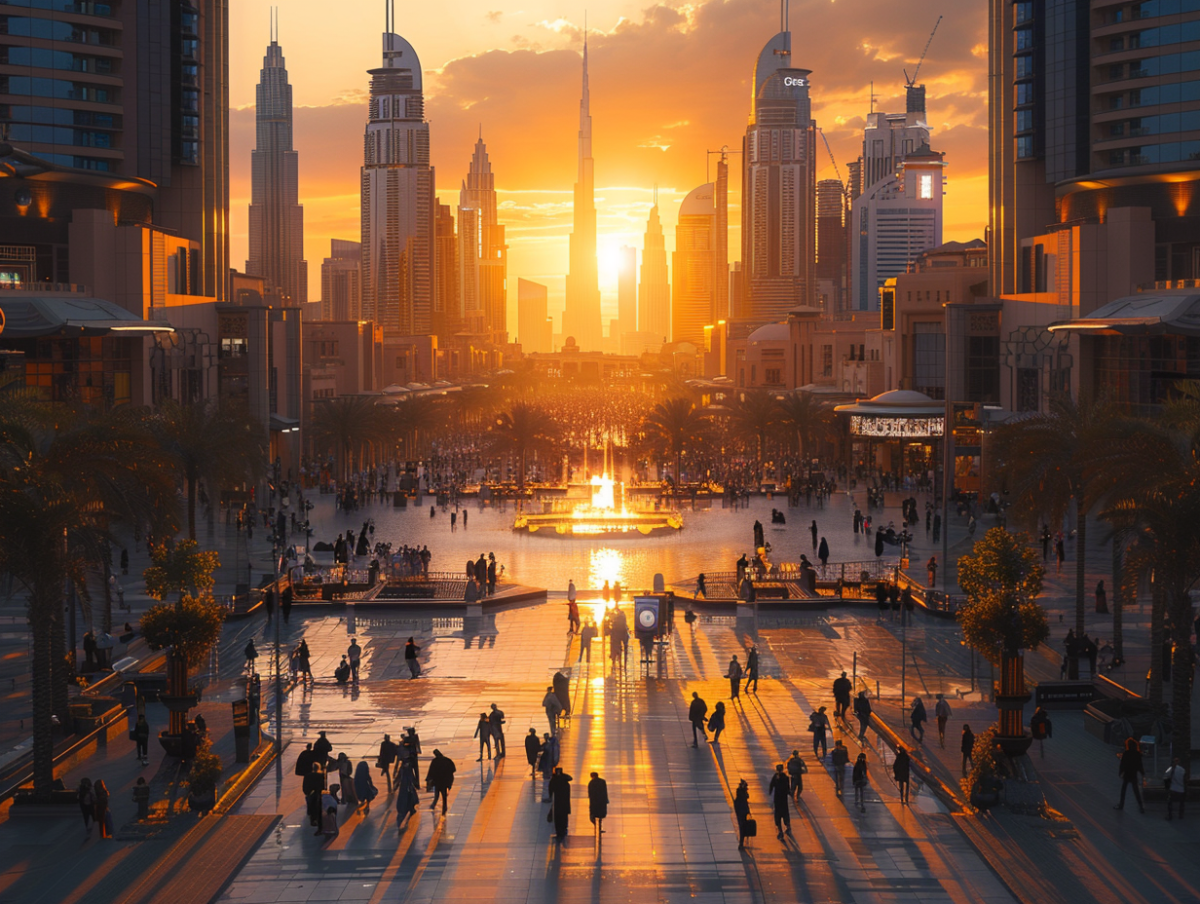
Global metropolises carry a unique character within them, often captured in the letters that make up their names. From A for Amsterdam to Z for Zurich, each city depicts a story, a culture, and an identity of its own. Let’s imagine an alphabetical journey through these urban centers, where each stop would be a letter, a symbol of what the city has to offer. This exploration takes us across continents, architectures, and societies, reflecting the diversity and richness of the global urban fabric. It is a journey that is both geographical and alphabetical, revealing surprising facets of our world.
Alphabetical Exploration of Global Metropolises
Lille, a city in the heart of Northern Europe, stands out in the cities’ alphabet by its initial letter, a gateway to an urban journey where each stop is a discovery. Articulating an overview of the major cities of the globe is akin to adopting a travel diary, where sketches of New York overlap with watercolors of Paris. Lille, with its cultural palette, contributes to this urban patchwork, notably through the Palais des Beaux-Arts, where the art of trompe-l’œil, under the brushes of François Boucq, invites reflection on the perception of space and art.
Beyond Boucq’s creations, Lille also breathes through its cobblestone streets and colorful facades, which seem to have emerged from the pages of a sketchbook. It is this same spirit that can be found in the work of a local artist, whose exhibition ‘Trompe l’œil at the museum’ offers an immersive scenography. The character of Moucherot, an emanation of Boucq’s pen, joins this scene, adding a touch of whimsy and depth to the visit, brilliantly illustrating the ability of drawing to transform reality.
To project oneself into the narrative of a city is also to understand its subtleties, its unspoken elements, its contrasts. Consider the capital starting with G, where modernity and historical heritage coexist. This city, which will not be named here, perfectly embodies the duality that often animates large metropolises. It tells its story not only through its monuments and history but also through the rhythm of life of its inhabitants, through its green spaces that dot the urban landscape, and through its cafés that punctuate lively discussions.
The approach of the travel diary, applied to urban discovery, is an invitation to see beyond the facades, to grasp the soul of the cities. François Boucq’s approach, which combines text and image, exemplifies this quest for meaning. It is a way to document the urban experience, to inscribe it in a visual narrative, to engrave it in the marble of our memories. The metropolises, from Lille to this capital starting with G, reveal themselves to be open books, where each street is a line, each square a chapter, each city a complete story.

From A to Z: A Journey Through Cities and Their Uniqueness
Approaching the narrative of cities by their initial letter invites a journey where each name evokes a color, a texture, a scent. Through this urban alphabet, cities reveal themselves in their cultural diversity and rich heritage. François Boucq, a comic book artist from Lille, has become the architect of such a journey at the Palais des Beaux-Arts in Lille. His exhibition ‘Trompe l’œil at the museum’ offers an experience where visitors are invited to dive into a universe where the boundary between art and reality blurs.
The Palais des Beaux-Arts in Lille, the stage for this artistic exploration, stands as a witness to history and an actor in contemporary culture. The scenography imagined by Boucq plays a central role, creating a dialogue between the artwork and the space that hosts it. Moucherot, Boucq’s flagship character, joins this staging and becomes a companion for visitors, guiding them through optical illusions and graphic narratives.
In this approach, the urban narrative takes on the appearance of a travel diary, where text intertwines with image to tell the city. This genre, popularized by authors such as Peter Sís and enriched by the works of Pascale Argod or Laure Witschger, places personal experience at the center of discovery. Like the pages of a diary that turn, the streets and squares of Lille are read and interpreted, offering the traveler a visual narrative of the city.
The city thus becomes more than just a place; it transforms into a living work, an open book where each passerby is both a reader and a narrator. The example of François Boucq, who through his drawings invites a multidimensional reading, reflects this conception of the city as a palimpsest, where each layer of history and urban life intertwines. Metropolises, from the most famous to the most discreet, reveal themselves to be spaces of creation, where the art of scenography and visual narration allows us to see and understand their essence.